Determination into the death of TC
Ampersand’s James McConnell K.C. acted for Greater Glasgow Health Board in this Fatal Accident Inquiry. The Inquiry was into the circumstances in which TC, a psychiatric out-patient, ended his own life. The Inquiry was presided over by Sheriff Paul Anthony Reid. He concluded inter alia that the deceased had received the correct treatment from a treating psychiatrist, and made no recommendations. His Determination can be accessed here.
Back
Ampersand Advocates welcomes 2 new members: Sarah McWhirter and Tony Convery
Ampersand is delighted to welcome Sarah McWhirter and Tony Convery to the stable, following their call to the Bar on Friday, 27th June 2025.
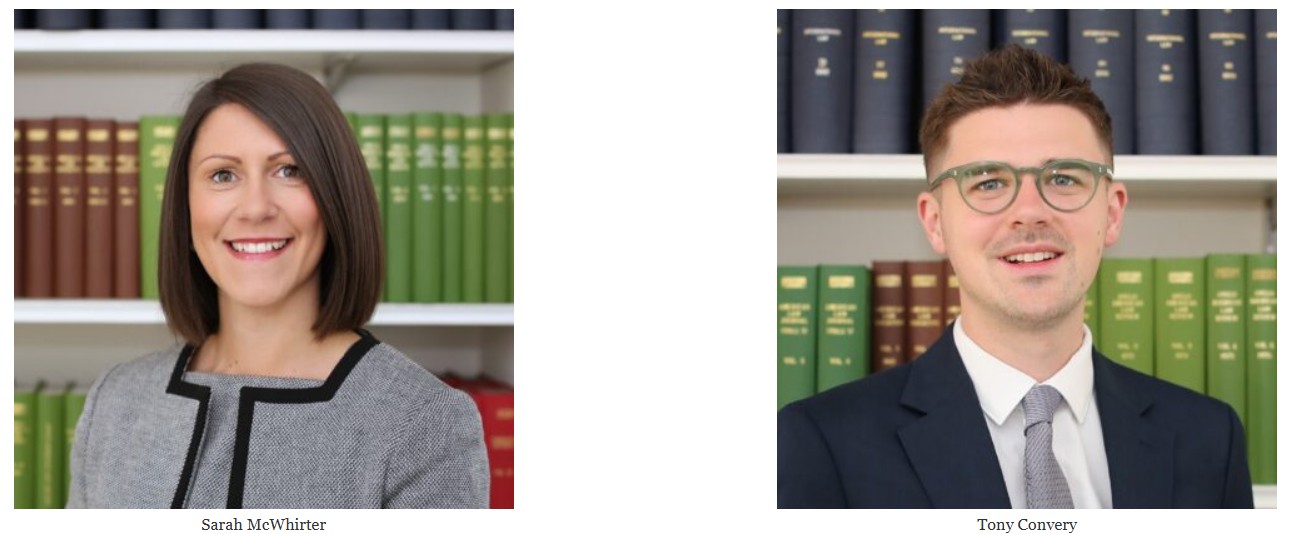
On the new members’ arrival, Stable Director Isla Davie KC, said: “We are delighted that Sarah and Tony are joining Ampersand. They are already highly regarded as lawyers, and this is the start of incredibly promising careers for both at the Bar. Not only does their considerable experience lend itself well to our existing practice areas, but they are also lovely people and we look forward to welcoming them into the stable.”
Ampersand’s Practice Manager, Alan Moffat added “I am delighted to welcome our newest members of Ampersand. Their addition to our set brings the membership to 61 and the experience which each of them brings is a fantastic fit for Ampersand’s core areas of practice. They will be a real asset to those looking to instruct counsel. I am sure that joining Ampersand will offer them rewarding opportunities and collaborative support”.
Sarah and Tony featured in Ampersand’s “& the Devils in the Detail” Hey Legal Live chat in May. You can watch clips of Sarah and Tony discussing their practice areas here.
Sarah McWhirter
Sarah specialises in clinical negligence and personal injury actions. She has extensive experience in complex and high-value claims. She has particular expertise in birth injury, spinal injury, amputation and fatal claims.
Prior to calling to the Bar, Sarah specialised in clinical negligence and personal injury work for over 10 years. Latterly, Sarah was Head of Clinical Negligence (Scotland) and a Principal Lawyer (partner) at a large UK-wide firm. She was ranked ‘Band 1’ in Chambers and Partners for Clinical Negligence: Mainly Claimant (2025). Sarah has experience of representing both pursuers and defenders.
As a solicitor Sarah, appeared in the All-Scotland Sheriff Personal Injury Court and regularly dealt with cases raised in the Court of Session.
During devilling, Sarah enhanced her existing experience in clinical negligence and personal injury work. She expanded her knowledge of specialist personal injury claims, including industrial disease and historical child abuse. She also gained experience in other areas of law, most notably mental health, professional regulation and public law.
Sarah is the Course Organiser for the Personal Injury elective course on the Diploma in Professional Legal Practice at the University of Edinburgh.
Tony Convery
Tony specialises in commercial litigation and public law. He calls to the Bar as the Lord Reid Scholar. That Scholarship is awarded annually to the outstanding candidate. He previously worked at a leading commercial law firm.
Tony has considerable commercial litigation experience, including in professional negligence, company and property law disputes. He also has experience of group proceedings, procurement litigation and proceedings before the Competition Appeal Tribunal.
Tony has a broad public law practice. As well as core constitutional and administrative law, Tony has experience in: (i) equality and human rights, (ii) planning and (iii) information law (including data protection and freedom of information). He has a wealth of experience in advising on legislative competence challenges.
Tony also has experience of acting in environmental, regulatory, education and media law disputes, as well as inquiries. He provides advice on trade/financial sanctions and related regulatory schemes.
Tony was a research assistant to Professor Jim Murdoch CBE in relation to the fourth edition of the leading textbook, Human Rights Law in Scotland. He has also published in his own right. He is a tutor at the University of Glasgow.
For further information about their practices view their profiles on the Ampersand Advocates website: Our People – Ampersand Advocates
To instruct either of them, please contact the Ampersand Clerking Team: ampersandclerks@advocates.org.uk.
Back
Tony Convery
Tony Convery specialises in commercial litigation and public law. He called to the Bar in 2025 as the Lord Reid Scholar. That Scholarship is awarded annually to the outstanding candidate. He previously worked at a leading commercial law firm.
Tony has considerable commercial litigation experience, including in professional negligence, company and property law disputes. He also has experience of group proceedings, procurement litigation and proceedings before the Competition Appeal Tribunal.
Tony has a broad public law practice. As well as core constitutional and administrative law, Tony has experience in: (i) equality and human rights, (ii) planning and (iii) information law (including data protection and freedom of information). He has a wealth of experience in advising on legislative competence challenges.
Tony also has experience of acting in environmental, regulatory, education and media law disputes, as well as inquiries. He provides advice on trade/financial sanctions and related regulatory schemes.
Tony was a research assistant to Professor Jim Murdoch CBE in relation to the fourth edition of the leading textbook, Human Rights Law in Scotland. He has also published in his own right. He is a tutor at the University of Glasgow.
Back
Sarah McWhirter
Sarah McWhirter specialises in clinical negligence and personal injury actions. She has extensive experience in complex and high-value claims. She has particular expertise in birth injury, cases involving neonatal death, spinal injury, amputation and fatal claims.
Sarah has experience of representing both pursuers and defenders. She also has experience of conducting Fatal Accident Inquiries.
Prior to calling to the Bar in 2025, Sarah specialised in clinical negligence and personal injury work for over 10 years. Latterly, Sarah was Head of Clinical Negligence (Scotland) and a (Principal Lawyer (partner) at a large UK-wide firm. She was ranked ‘Band 1’ in Chambers and Partners for Clinical Negligence: Mainly Claimant (2024).
During devilling, Sarah enhanced her existing experience in clinical negligence and personal injury work. She expanded her knowledge of specialist personal injury claims, including catastrophic personal injury and industrial disease claims. She also gained experience in other areas of medical law, most notably mental health, professional regulation and public law.
Sarah is the Course Organiser for the Personal Injury elective course on the Diploma in Professional Legal Practice at the University of Edinburgh.
Back
Jack Mackenzie FAI
Ampersand counsel Douglas Ross KC, Isla Davie KC and Shane Dundas recently represented key parties in a significant Fatal Accident Inquiry into the tragic death of Jack McKenzie at HM Prison and Young Offenders Institution Polmont. The Inquiry was heard by Sheriff Collins KC who also issued the determination in the Inquiry into the deaths of Katie Allan and William Brown in January of this year following their deaths by suicide in Polmont.
Jack McKenzie, aged 20, tragically died by suicide in his cell at Polmont in September 2021. In his determination, Sheriff Collins noted several failures, particularly around ligature anchor points within Jack’s cell. His Lordship found that a reasonable precaution, which might realistically have resulted in the death being avoided, would have been for SPS to replace or modify the toilet cubicle door within Jack’s cell so that it was not readily capable of being used as a ligature anchor point. The Inquiry also identified that the lack of audit and subsequent removal of anchor points in Jack’s cell was a defect in the system of work which contributed to his death.
Several recommendations were made in relation to the auditing and modifying of cell structures, improving suicide risk assessment protocols, particularly for prisoners who suffer from drug abuse issues, and reintroducing certain cell safety checks.
You can read the full determination by Sheriff Collins KC here.
Back
Determination into the deaths of Leo Lamont, Ellie McCormick and Mira-belle Bosch [2025] FAI 15
Ampersand’s Vinit Khurana KC acted for the Scottish Ambulance Service and James McConnell KC and Scott Clair acted for Greater Glasgow Health Board in this Fatal Accident Inquiry. The Inquiry was into three neonatal deaths, and was presided over by Sheriff Principal Anwar. Her detailed determination, extending to over two hundred pages, can be accessed here.
Back