Ampersand Advocates shines in outstanding Chambers & Partners UK Bar 2027 Rankings
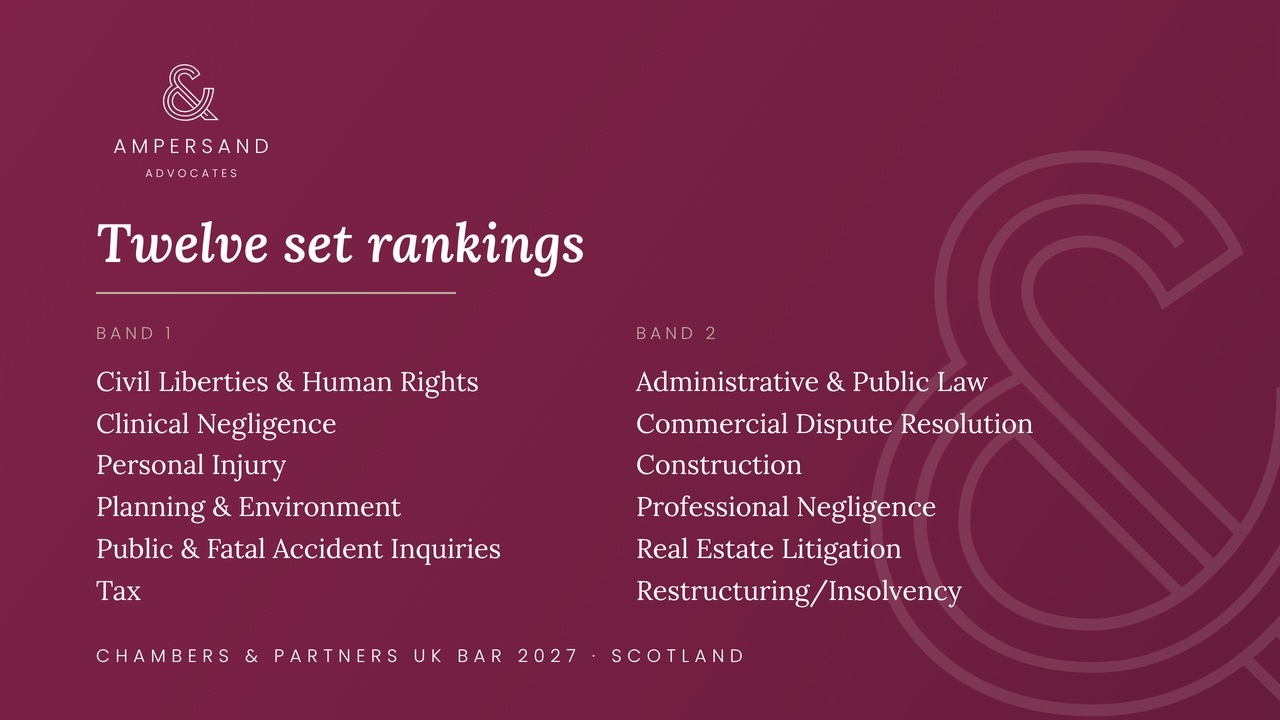
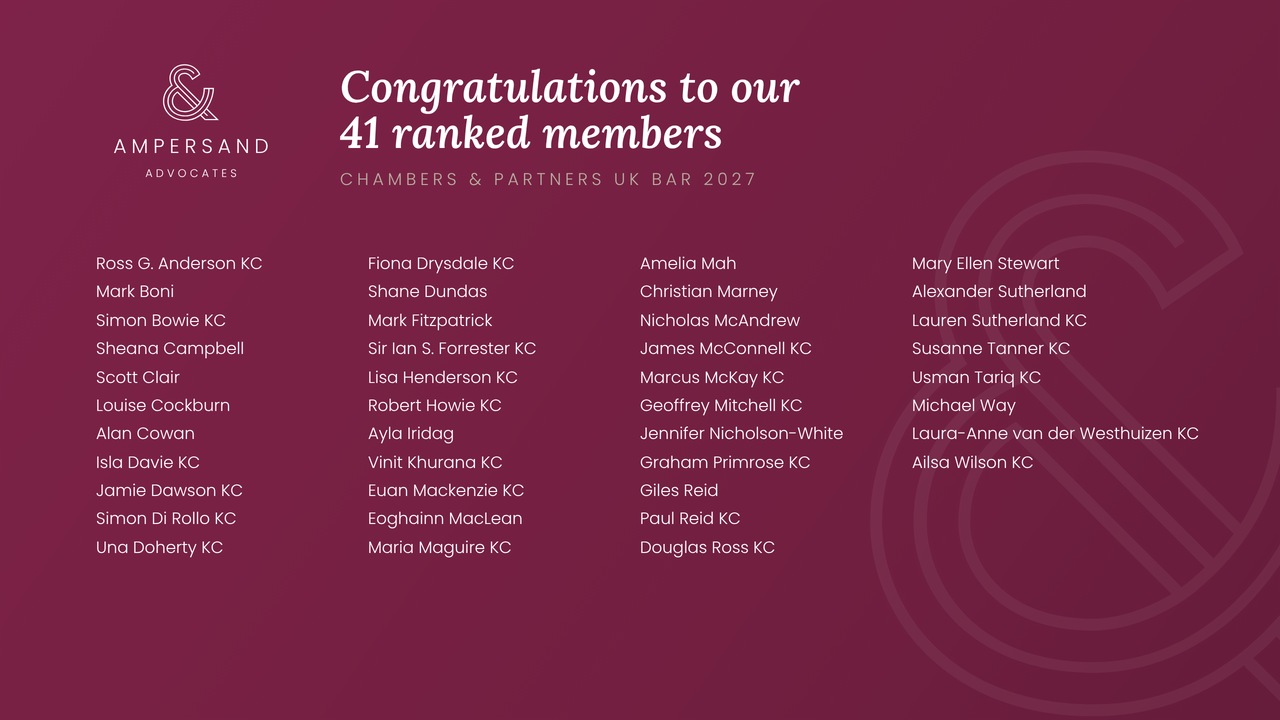
Ampersand Advocates has been ranked in twelve practice areas in the Chambers & Partners UK Bar 2027 guide, with six in Band 1, and 41 of our members hold 94 individual rankings between them across 20 practice areas.
All twelve of the set rankings we held in last year’s guide are retained, and one has moved up.
Civil Liberties & Human Rights rises from Band 2 to Band 1, joining Clinical Negligence, Personal Injury, Planning & Environment, Public & Fatal Accident Inquiries and Tax. Maria Maguire KC is ranked as a Star Individual in both Clinical Negligence and Personal Injury, and Graham Primrose KC is a Star Individual in Personal Injury.
The rankings are based on interviews with the solicitors and clients who instruct us, and we are grateful to everyone who took the time to speak to Chambers. Their comments, a selection of which appear below, are the best measure of the work our members do.
Set rankings
Practice areas and ranked members
Administrative & Public Law – Band 2
Chambers Review: A “wide variety of counsel with different specialisms”
“If you have a contentious IP case, he is first name on the list.” – on Usman Tariq KC, Intellectual Property
“Amelia is brilliantly clever, a pleasure to deal with and incredibly responsive.” – on Amelia Mah, Intellectual Property
Star Individuals
Maria Maguire KC (Clinical Negligence and Personal Injury) and Graham Primrose KC (Personal Injury) are ranked as Star Individuals, the highest individual ranking Chambers awards.
Up and Coming
Five of our juniors are recognised as Up and Coming: Ayla Iridag (Administrative & Public Law, Civil Liberties & Human Rights and Personal Injury), Scott Clair (Civil Liberties & Human Rights, Professional Discipline and Professional Negligence), Amelia Mah (Intellectual Property), Mary Ellen Stewart (Public & Fatal Accident Inquiries) and Shane Dundas (Public & Fatal Accident Inquiries).
Breadth of practice
Many of our members are ranked across several areas. Usman Tariq KC holds nine rankings, Paul Reid KC and Ross G. Anderson KC six each, and Michael Way five. Ross, who took silk this year, is ranked in Band 1 in five practice areas: Commercial Dispute Resolution, Company, Real Estate Litigation, Restructuring/Insolvency and Tax.
Clerking
Our clerking team, led by Advocates’ Clerk Alan Moffat, is again singled out by those who instruct us.
“All of the clerks are very good and responsive. Head clerk Alan Moffat is particularly good. He comes to me with solutions rather than leaving it with me to deal with.” – Personal Injury
“Alan Moffat is one of the go-to people if you need to get a counsel, and he is always able to provide good advice on who would be suitable for a matter.” – Commercial Dispute Resolution
“The clerks will bend over backwards to accommodate you and help you find counsel, even in challenging situations.” – Clinical Negligence
Congratulations to every member recognised this year, and thank you to our clients and instructing solicitors for their continued trust.
Ampersand Advocates continues its reputation as one of Scotland’s leading stable for excellence across the civil Bar. Ampersand stands out for its depth, versatility, and advocacy excellence.
The full rankings and editorial are available on the Chambers & Partners website. To instruct any of our members, contact the clerks on 0131 260 5674 or at ampersandclerks@advocates.org.uk.
Legal 500 2027: Ampersand Advocates Recognised Across the Scottish Bar
Ampersand Advocates is delighted to have secured another outstanding set of results in the Legal 500 2027 Scottish Bar rankings, with the Stable achieving Tier 1 rankings in Administrative & Public Law, Crime, Regulatory & Inquiries, Personal Injury & Medical Negligence, and Property, Planning & Construction, together with a Tier 2 ranking in Commercial Disputes. The rankings demonstrate the continued strength of the Stable at every level, with more than 40 individual recognitions spanning five key practice areas. Across the rankings, members have been recognised as Leading Silks, Senior Counsel, Leading Juniors, Junior Counsel, 2026 Silks and Rising Stars, underlining the depth and breadth of expertise available across the Stable.
The clerking team was commended for their efficiency and responsiveness. This recognition reflects the significant contribution made by the clerks in supporting both counsel and agents and ensuring the highest standards of service across the Stable.
Administrative & Public Law (Tier 1)
Ampersand retained its Tier 1 ranking in Administrative & Public Law. Legal 500 highlights the Stable’s strength in judicial review and public law litigation, noting members’ involvement in high-profile cases and matters engaging human rights issues.
Ampersand maintained its strong standing in Commercial Disputes. The rankings reflect expertise across intellectual property, competition, professional negligence, technology disputes and complex commercial litigation.
Further recognition comes through Scott Clair, who is named as a Rising Star (Tier 1) in Commercial Disputes.
Crime, Regulatory & Inquiries (Tier 1)
Ampersand continues to be recognised as a leading Stable for criminal, regulatory and inquiry work. Legal 500 highlighted members’ roles in major public inquiries reflecting the Stable’s significant presence in some of the most high-profile public law and regulatory matters in Scotland.
Scott Clair also secures recognition as a Rising Star (Tier 1) in this practice area.
Personal Injury & Medical Negligence (Tier 1)
Ampersand remains a Tier 1 Stable for Personal Injury & Medical Negligence.
The results are particularly impressive at silk level, with a substantial concentration of Tier 1 rankings demonstrating the significant strength of Ampersand’s senior counsel offering in clinical negligence, catastrophic injury and complex reparation work.
Scott Clair notably achieves further recognition as a Rising Star (Tier 1).
Property, Planning & Construction (Tier 1)
The stable retained its Tier 1 ranking in Property, Planning & Construction, with Legal 500 highlighting the Stable’s involvement in significant planning, development and infrastructure matters throughout Scotland, reflecting the depth of expertise available in this specialist area.
Elsewhere, Mark Boni achieves Tier 1 Leading Junior recognition in the Private Client and Family listings.
Collectively, the 2027 rankings reinforce Ampersand Advocates’ reputation as one of Scotland’s leading stables, demonstrating exceptional strength from established market-leading silks through to an increasingly prominent junior bar.
Full listings, for all of Ampersand’s rankings can be viewed on the Legal 500 website, here.
Ross Anderson new King’s Counsel appointment at Ampersand Advocates
Congratulations to Ampersand’s Ross Anderson KC on taking silk. Ross is amongst sixteen new silks announced today, appointed by His Majesty the King on the recommendation of First Minister John Swinney.
The rank of King’s Counsel is generally reserved for those who have distinguished themselves in practice in the Supreme Courts. Advocates and Solicitors with Rights of Audience in the Supreme Courts are eligible to apply to the Lord Justice General, Scotland’s senior judge. Before making nominations to the First Minister, the Lord Justice General consults other judges, the Lord Advocate, the Dean of the Faculty of Advocates and the President of the Law Society of Scotland.
Ross’s practice focuses on commercial dispute resolution, company and insolvency law, property law, public law, trusts and tax. Ross was a standing junior counsel to the UK Government (having been assigned to HM Revenue & Customs from 2015-2024). He appears regularly in UK tribunals as well as in the Court of Session.
Stable Director Isla Davie KC said: “I congratulate Ross on this well deserved appointment as King’s Counsel. He is an excellent Advocate held in high regard in the profession and this appointment further strengthens Ampersand’s offering of first class Senior Counsel.”
The full list of new silks can be found on the Judiciary of Scotland website here.
Court of Session issues decision on Scottish Ministers’ petition for removal of Irish Travellers from Edinburgh development site
[2026] CSOH 82 – Petition of the Scottish Ministers for an order under section 46 of the Court of Session Act 1988 and for interdict and interdict ad interim
Lady Tait has issued an opinion in a case where the petitioners, the Scottish Ministers, sought an order under section 46 of the Court of Session Act 1988: (i) ordering the occupants to remove themselves, their caravans and all other goods from the site to restore possession of the site to the petitioners; and (ii) to interdict the occupants from entering the site.
Chris Stephen was instructed by the Scottish Human Rights Commission (SHRC) as the First Interested Party to produce a Minute of Written Submission addressing the UNCRC requirements under the United Nations Convention on the Rights of the Child (Incorporation)(Scotland) Act 2024.
Summary
The petitioners are proprietors of an area of land. Planning permission has been granted for the development of the site. The respondent Is an Irish Traveller. The respondent and his family have occupied an area of the site since 2024. The respondent submitted that in circumstances where no culturally appropriate accommodation would be made available on eviction, the orders would constitute an unlawful interference with the respondent’s rights under Articles 8 and 14 of the European Convention on Human Rights (“ECHR”). It was also submitted they would also be incompatible with the respondent’s children’s rights under the United Nations Convention on the Rights of the Child (“UNCRC”).
Outcome
There was no dispute that the petitioners’ redevelopment project was capable of constituting a legitimate aim, and that vacant possession of the site was rationally connected to that objective. The question for the court was whether an order to evict the respondent in the absence of appropriate alternative accommodation was a proportionate means of achieving that legitimate aim. Lady Tait concluded that there was no less intrusive measure than eviction and that the importance and urgency of the petitioners’ objectives outweighed the severity of the effect of the eviction. In those circumstances, the interference with the respondent’s Article 8 rights was proportionate. Nor was there an evidential basis to submit that the family had been discriminated against by the petitioners under Article 14.
With regards to the children’s rights under the UNCRC, it was accepted that the petitioners and the court were exercising a relevant function under the 2024 Act. However, there was no less intrusive measure than eviction and that the importance and urgency of the petitioners’ objectives outweighed the severity of the effect of the eviction. The current absence of accommodation did not elevate the site into one which was appropriate for the family and which served the children’s best interests.
Lady Tait granted the prayer of the petition and the orders sought. The opinion is available on the Scottish Courts and Tribunals Service website here.
Lord Braid has issued a single opinion addressing three petitions presented to the Court of Session within a period of around two weeks, each inviting the court to exercise its parens patriae jurisdiction to authorise medical treatment for a child whose parents had refused consent.
Three members of Ampersand appeared for the petitioning health boards, instructed in each case by the NHS Scotland Central Legal Office: Scott Clair for Greater Glasgow Health Board in respect of child A, Louise Jardine for Greater Glasgow Health Board in respect of child B, and Paul Reid KC for Borders Health Board in respect of child C.
The three cases
Child A was a 13-year-old boy with medulloblastoma, an aggressive brain cancer. He had severe non-verbal autism and was assessed as lacking capacity to make decisions about his healthcare. He and his parents are Jehovah’s Witnesses, and his parents had confirmed that they would not consent to the transfusion of primary blood components. Authority was sought for a course of radiotherapy followed by chemotherapy, and for transfusion if the treating clinician considered it necessary to avoid serious harm including death.
Child B was a 3-year-old requiring an open pyeloplasty for a pelvi-ureteric junction obstruction, whose surgery had been complicated by a subsequent diagnosis of sickle cell disease. His parents, also Jehovah’s Witnesses, refused consent to any blood products. Clinicians had used an alternative regimen to raise his haemoglobin above the surgical threshold, but could not rule transfusion out entirely, particularly in the event of post-operative complications.
Child C was a 10-year-old girl bitten by the family dog, who required tetanus-containing vaccination and immunoglobulin within four days of the injury. She had not previously been vaccinated. Her parents refused consent and, unlike in the first two cases, actively opposed the petition, disputing the medical evidence and addressing the court both orally and in writing.
In each case a curator ad litem was appointed on presentation of the petition, each curator supported the petition, and the court granted an order permitting medical intervention — though not, in every case, in the terms originally sought.
Points of wider significance
Lord Braid took the opportunity to address several matters going beyond the individual cases.
On the scope of the jurisdiction, he held that a child need not be an orphan for parens patriae to be engaged. Where the welfare of the child requires parental consent to a necessary procedure and that consent is not available, it does not matter whether the reason is that no parent is alive, that a parent cannot be found, or that a parent is refusing consent on religious, moral or life-choice grounds. In such circumstances the court is, in effect, “acting as a third parent.”
He emphasised that any such authorisation is an exception to parental autonomy and an interference by an organ of the state in family life. It must be a proportionate response to a material risk, and requires a balancing exercise at the heart of which lies the welfare of the child, but in which the parents’ wishes, religious beliefs and right to parental autonomy must also be weighed.
On the limits of the jurisdiction, the opinion is instructive. In child C’s case, the petition as presented had also sought authority for two further doses of vaccine at monthly intervals. The curator elicited from the treating clinician that those doses were not related to the acute episode but were intended to bring the child into the routine childhood vaccination schedule. The court observed that this would go considerably beyond the proper compass of an exception to parental autonomy; the jurisdiction enables the court to intervene in urgent situations, not to impose measures against parents’ wishes. Senior counsel for the health board confirmed at the interim hearing that the order was no longer sought in those terms.
On procedure, the opinion confirms that RCS 14.7 states in terms that a parens patriae petition shall not be intimated on the walls of court, and that it is not open to the court to waive that requirement. There is accordingly no need to seek dispensation. Open justice is served by the petitions being heard in open court, with the family’s privacy preserved by anonymity orders.
The opinion also addresses the interaction with the UNCRC (Incorporation) (Scotland) Act 2024, the court being satisfied that the UNCRC requirements were in any event consistent with Scots law.
Finally, in a postscript prompted by a recent academic suggestion that a child protection order should be sought in such cases, Lord Braid expressed no concluded view but observed that it had not struck him that a child protection order ought to have been sought in any of the three cases. There were no social work concerns; all were loving parents acting in accordance with what they perceived to be their child’s best interests; and it is not obvious that the statutory mechanism provides the same safeguards, including the power to seek a curator’s report and the hearing of applications in public. As Lord Braid put it, “the procedural cart must not drive the welfare horse.”
The opinion is available on the Scottish Courts and Tribunals Service website here.
Ampersand Advocates’ Tony Convery acted as junior counsel for the successful petitioner (with Aidan O’Neill KC as Senior Counsel), instructed by Balfour + Manson.
The petitioner challenged guidance (“Prisons Guidance”) issued by the Scottish Prison Service, related to the management of transgender prisoners.
Lady Ross held that the relevant statutory schemes required separate prison accommodation for men and women, in accordance with biological sex.
She found that the Prisons Guidance conflicted with those requirements insofar as it purported to allow the Scottish Prison Service to accommodate transgender prisoners in prisons for the opposite biological sex.
She also found that the application of the Prisons Guidance by the Scottish Ministers would be outside their powers under the Scotland Act 1998.


 Ampersand Advocates has been ranked in twelve practice areas in the Chambers & Partners UK Bar 2027 guide, with six in Band 1, and 41 of our members hold 94 individual rankings between them across 20 practice areas.