Legal 500 2027: Ampersand Advocates Recognised Across the Scottish Bar
Ampersand Advocates is delighted to have secured another outstanding set of results in the Legal 500 2027 Scottish Bar rankings, with the Stable achieving Tier 1 rankings in Administrative & Public Law, Crime, Regulatory & Inquiries, Personal Injury & Medical Negligence, and Property, Planning & Construction, together with a Tier 2 ranking in Commercial Disputes. The rankings demonstrate the continued strength of the Stable at every level, with more than 40 individual recognitions spanning five key practice areas. Across the rankings, members have been recognised as Leading Silks, Senior Counsel, Leading Juniors, Junior Counsel, 2026 Silks and Rising Stars, underlining the depth and breadth of expertise available across the Stable.
The clerking team was commended for their efficiency and responsiveness. This recognition reflects the significant contribution made by the clerks in supporting both counsel and agents and ensuring the highest standards of service across the Stable.
Administrative & Public Law (Tier 1)
Ampersand retained its Tier 1 ranking in Administrative & Public Law. Legal 500 highlights the Stable’s strength in judicial review and public law litigation, noting members’ involvement in high-profile cases and matters engaging human rights issues.
Within the Leading Silks rankings, Douglas Ross KC and Susanne Tanner KC are recognised in Tier 1, while Paul Reid KC, Usman Tariq KC and Laura-Anne Van Der Westhuizen KC are recognised in Tier 2. Ross Anderson KC has been recognised as a Tier 1 2026 Silk. Ampersand’s emerging talent is also recognised through Michael Way as a Leading Junior (Tier 2) and Scott Clair, who is a Rising Star (Tier 1) in the field, reflecting their growing reputations in this area.
Commercial Disputes (Tier 2)
Ampersand maintained its strong standing in Commercial Disputes. The rankings reflect expertise across intellectual property, competition, professional negligence, technology disputes and complex commercial litigation.
Within the Leading Silks, Robert Howie KC, Usman Tariq KC and Laura-Anne Van Der Westhuizen KC are recognised as Tier 2 Silks with Ross Anderson KC as a Tier 1 2026 Silk.
Ampersand’s junior bar is well represented in this area. Eoghainn MacLean is recognised as a Tier 1 Leading Junior, while Mark Boni, Nicholas McAndrew and Giles Reid are all ranked as Tier 2 Leading Juniors.
Further recognition comes through Scott Clair, who is named as a Rising Star (Tier 1) in Commercial Disputes.
Crime, Regulatory & Inquiries (Tier 1)
Ampersand continues to be recognised as a leading Stable for criminal, regulatory and inquiry work. Legal 500 highlighted members’ roles in major public inquiries reflecting the Stable’s significant presence in some of the most high-profile public law and regulatory matters in Scotland.
Among the Leading Silks we have Isla Davie KC recognised at Tier 1 with Simon Bowie KC, Jamie Dawson KC, Una Doherty KC, Fiona Drysdale KC, James McConnell KC, Geoffrey Mitchell KC, Paul Reid KC, Susanne Tanner KC and Usman Tariq KC all recognised as Tier 2 Leading Silks.
At Leading Junior level, Ayla Iridag and Shane Dunas are recognised as a Tier 1 while Jennifer Nicholson-White and Michael Way are both ranked within Tier 2.
Scott Clair also secures recognition as a Rising Star (Tier 1) in this practice area.
Personal Injury & Medical Negligence (Tier 1)
Ampersand remains a Tier 1 Stable for Personal Injury & Medical Negligence.
The results are particularly impressive at silk level, with a substantial concentration of Tier 1 rankings demonstrating the significant strength of Ampersand’s senior counsel offering in clinical negligence, catastrophic injury and complex reparation work.
The Stable boasts an exceptional group of Leading Silks Tier 1, comprising Simon Bowie KC, Una Doherty KC, Lisa Henderson KC, Maria Maguire KC, Geoffrey Mitchell KC, Graham Primrose KC and Lauren Sutherland KC. Further recognition is given to Isla Davie KC, Vinit Khurana KC, Euan Mackenzie KC, James McConnell KC, Paul Reid KC and Douglas Ross KC, all ranked as Tier 2 Silks.
At Leading Junior level, Jennifer Nicholson-White achieves a Tier 1 ranking, while Shane Dundas and Ayla Iridag are both recognised as Tier 2 Leading Juniors.
Scott Clair notably achieves further recognition as a Rising Star (Tier 1).
Property, Planning & Construction (Tier 1)
The stable retained its Tier 1 ranking in Property, Planning & Construction, with Legal 500 highlighting the Stable’s involvement in significant planning, development and infrastructure matters throughout Scotland, reflecting the depth of expertise available in this specialist area.
Within the Leading Seniors ranks, Robert Howie KC and Ailsa Wilson KC are recognised as Tier 1 Silks, while Marcus McKay KC and Laura-Anne Van Der Westhuizen KC are ranked as Tier 2 Silks. Ross Anderson KC is recognised as a Tier 1 2026 Silk
At the junior bar, Eoghainn MacLean and Nicholas McAndrew receive Tier 1 recognition as Leading Juniors, while Louise Cockburn, Giles Reid and Alexander Sutherland are ranked as Tier 2 Leading Juniors.
Elsewhere, Mark Boni achieves Tier 1 Leading Junior recognition in the Private Client and Family listings.
Collectively, the 2027 rankings reinforce Ampersand Advocates’ reputation as one of Scotland’s leading stables, demonstrating exceptional strength from established market-leading silks through to an increasingly prominent junior bar.
Full listings, for all of Ampersand’s rankings can be viewed on the Legal 500 website, here.
Back
Supreme Court refuses appeal in Rogano restaurant dispute – Forthwell Limited v Pontegadea UK Limited [2026] UKSC 33

The Supreme Court has issued its decision in Forthwell Limited v Pontegadea UK Limited – [2026] UKSC 33. The case concerned liability for repairs and lost profits at the Rogano restaurant in Glasgow. Forthwell was the only Scottish appeal heard by the Supreme Court during its visit to Glasgow in May this year. Although the case settled shortly before the hearing, the Supreme Court heard the appeal given the wider importance of the issues raised. Giles Reid was junior counsel for the successful landlord.
In Forthwell the pursuer was the tenant of the Rogano restaurant. The restaurant suffered damage from water ingress in 2020. The pursuer brought a claim against the landlord seeking implement of the landlord’s obligation to restore the premises. The restaurant itself was operated by a third-party licensee in the pursuer’s company group, Lynnet Leisure (Rogano) Ltd. The pursuer also attempted to recover Lynnet’s loss of profit for the period in which the restaurant was closed. The defender argued that this loss was not recoverable in as a matter of law.
The decision concerns the circumstances in which a pursuer can recover a third party’s losses in an action for breach of contract. The Supreme Court, refusing the pursuer’s appeal from the Inner House, held that earlier Scottish authorities had been wrongly decided in holding that a pursuer generally may sue for a third party’s loss where that loss would otherwise not be recoverable (sometimes terms a legal ‘black hole’). The Supreme Court clarified that the ability to recover a third party’s loss is a narrow exception to the ordinary position where privity of contract prevents recovery. In Scots law, recovery will only be possible on the so-called ‘narrow ground’ where damage is caused to property that is intended to be transferred to a third party. The Supreme Court left open the question of whether recovery on the so-called ‘broader’ ground (where it is parties’ intention that a contract will confer a benefit on a third party) forms part of Scots law or English law.
The Supreme Court’s decision is a significant development of the law in this area. It is the first time that the Supreme Court or House of Lords has considered the recoverability of such losses in Scots law. It will be of considerable importance to those advising on breaches of contract and, in particular, on claims involving damage to property.
Back
Ross Anderson new King’s Counsel appointment at Ampersand Advocates

Congratulations to Ampersand’s Ross Anderson KC on taking silk. Ross is amongst sixteen new silks announced today, appointed by His Majesty the King on the recommendation of First Minister John Swinney.
The rank of King’s Counsel is generally reserved for those who have distinguished themselves in practice in the Supreme Courts. Advocates and Solicitors with Rights of Audience in the Supreme Courts are eligible to apply to the Lord Justice General, Scotland’s senior judge. Before making nominations to the First Minister, the Lord Justice General consults other judges, the Lord Advocate, the Dean of the Faculty of Advocates and the President of the Law Society of Scotland.
Ross’s practice focuses on commercial dispute resolution, company and insolvency law, property law, public law, trusts and tax. Ross was a standing junior counsel to the UK Government (having been assigned to HM Revenue & Customs from 2015-2024). He appears regularly in UK tribunals as well as in the Court of Session.
Stable Director Isla Davie KC said: “I congratulate Ross on this well deserved appointment as King’s Counsel. He is an excellent Advocate held in high regard in the profession and this appointment further strengthens Ampersand’s offering of first class Senior Counsel.”
The full list of new silks can be found on the Judiciary of Scotland website here.
Back
Miranda Cannibal
Miranda Cannibal called to the Bar in 2026 as a Lord Hope Scholar, bringing nine years of post-qualification experience as a solicitor.
She has a broad civil and commercial practice, with considerable experience in commercial disputes, contentious construction, and professional negligence. Through devilling, she has also cultivated a developing interest in administrative law, with a particular focus on tax, planning, and environmental matters.
Before coming to the Bar, Miranda gained extensive advocacy experience across a wide range of forums, including adjudications, arbitrations, mediations, and professional disciplinary tribunals. She has considerable experience in the Sheriff Court, having appeared in proofs, debates, procedural hearings, and hearings for interim orders.
Miranda also tutors on the Civil Procedure Course at the University of Edinburgh’s Diploma in Professional Legal Practice.
Back
Ampersand Advocates welcomes 2 new members: Laura-anne Langlands and Miranda Cannibal
Ampersand is delighted to welcome Laura-anne Langlands and Miranda Cannibal to the stable, following their call to the Bar on Friday, 26th June 2026.
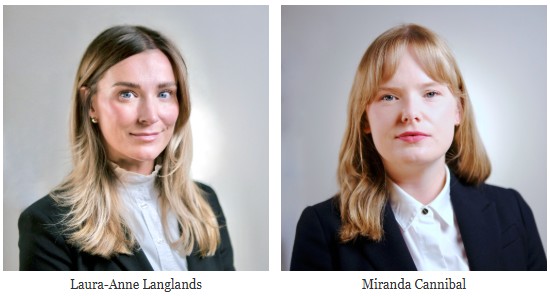 On the new members’ arrival, Stable Director Isla Davie KC, said: “We are delighted that Laura-anne and Miranda are joining Ampersand. They are already highly regarded as lawyers, and this is the start of incredibly promising careers for both at the Bar. Not only does their considerable experience lend itself well to our existing practice areas, but they are also lovely people. We look forward to welcoming them into the stable.”
Ampersand’s Practice Manager, Alan Moffat added “I am delighted to welcome our newest members of Ampersand. Their addition to our set brings the membership to 61 and the experience which each of them brings is a fantastic fit for Ampersand’s core areas of practice. They will be a real asset to those looking to instruct counsel. I am sure that joining Ampersand will offer them rewarding opportunities and collaborative support”.
Laura-anne and Miranda featured in the Ampersand Live podcasts “& the Devils in the Detail” earlier in June. You can watch clips of them discussing their practice areas below.
Laura-anne:
Miranda:
Watch their full podcasts on Ampersand’s LinkedIn page.
Laura-anne Langlands
Laura-anne has extensive experience of pursuer and defender clinical negligence work and pursuer and defender personal injury work having been a solicitor focusing on these practice areas for 16 years. During her time working at the Central Legal Office she represented health boards and dealt with workplace personal injury actions and many complex clinical negligence actions, including birth injury, delayed and misdiagnosis and fatal claims. When in private practice she primarily represented pursuers in high value catastrophic personal injury claims and fatal claims arising from accidents at work and road traffic accidents. She also acted for pursuers in complex clinical negligence matters.
Miranda Cannibal
Miranda is an advocate at Ampersand Advocates, bringing nine years’ post-qualification experience as a civil and commercial litigation solicitor specialising in construction and professional negligence disputes which she was recommended for in the Legal 500 as a solicitor. She has a strong track record across ADR and court, having conducted adjudications and arbitrations and appeared in proofs, debates and professional disciplinary proceedings. She also tutors on the Civil Procedure Court at the University of Edinburgh’s Diploma in Professional Legal Practice.
For further information about their practices view their profiles on the Ampersand Advocates website: Our People – Ampersand Advocates
To instruct either of them, please contact the Ampersand Clerking Team: ampersandclerks@advocates.org.uk.
Back
& the devil is in the detail: Miranda Cannibal
 In this Ampersand Live session, Alan Moffat is joined by Miranda Cannibal ahead of her call as an advocate at Ampersand.
Now available on demand, this was roadcast live on Tuesday 16 June 2026 at 12.30pm, with questions from Deputy Clerk Kathryn Ferguson.
Miranda reflects on her journey to the Bar – the career and experiences that led her here, what finally tipped the balance in favour of advocacy, and the realities of nine months of devilling at the Faculty of Advocates. She also looks ahead to calling and beyond: the areas she intends to focus on, and how her background will shape the work she takes on as an advocate.
For solicitors who instruct counsel, or for anyone weighing up the leap from private practice to the Bar, Miranda’s perspective is both practical and illuminating.
Back