Aidan O’Neill KC reflects on the decision in DALY v. HM ADVOCATE; KEIR v. HM ADVOCATE [2025] UKSC 38
Ampersand’s Aidan O’Neill KC, Senior counsel who acted for one of the appellants in the recent important decision of the UKSC in Daly provides some of his own reflections about the case.
In this interview Aidan O’Neill KC, who acted for the appellant Daly before the UK Supreme Court in Daly v. HM Advocate; Keir v. HM Advocate [2025] UKSC 38, reflects on the decision and its implications.
Question 1: What was the history of the Daly case prior to getting to the UK Supreme Court ?
The road to the UK Supreme Court in this case was not easy. It started off as an appeal against conviction to the High Court of Justiciary Appeal Court (“the Appeal Court”) on the grounds that the prosecution was oppressive, his conviction amounted to a miscarriage of justice, and his trial breached his rights to a fair trial under Article 6 ECHR.
Specifically the Grounds of Appeal asserted that the manner in which the trial had been conducted was made fundamentally unfair by the fact that the accused counsel had been unable to raise with – or cross-examine the complainer about – what the accused claimed was a demonstrably false allegation of rape against him which the complainer had made to the police, but which the Crown had chosen not to include on the indictment or in a docket.
The Grounds of Appeal did not pass the first sift (a single judge decision by Lord Mulholland on the papers) on the basis that none of the grounds of appeal was considered to be arguable.
The appellant applied for a second sift decision. This was considered (again on the papers) by the second sifting bench made up by Lord Pentland, Lady Wise, and Lord Summers. They confirmed the refusal of leave to appeal, on the basis that they considered the reasoning of the first sift judge to be soundly based and that the evidence relating to the allegation of rape which did not make it on the indictment “was indubitably collateral and a section 275 application seeking authority to introduce such evidence would have been bound to fail”.
The possibility of the review by the UKSC of the Convention compatibility of the decisions of the Appeal Court was made more difficult by the practice of that court to refuse to allow any Convention based challenges to its approach to pass the sist, and thereafter to refuse permission for their decision to be appealed to the UKSC . In Mirza v. HM Advocate [2015] HCJAC 87, 2016 JC 66 – a 3 judge bench made up of the then Lord Justice-Clerk (and subsequently Lord Justice General) Lord Carloway, Lady Smith and Lady Clark of Calton – stated at § 25:
“25. Leave to appeal [to the UK Supreme Court] is accordingly refused. It may be worth adding that, notwithstanding Cadder v. HM Advocate [2010] UKSC 43, 2011 SC (UKSC) 13, it will only be in exceptional circumstances that the court will grant leave in a case where the court has already decided at first and second sifts that there are no arguable grounds of appeal which would have permitted the case to proceed to a hearing on its merits”
Consistently with this approach, in Daly the same court (Lord Pentland, Lady Wise and Lord Summers) which had refused leave at second sift then refused the applicant’s application for its permission to appeal to the UK Supreme Court. They said that proposed appeal raised “no point of law of general public importance” and instead “the case involves the application of well-established principles and has no exceptional aspects”. Indeed the second sift bench decision refusing Daly permission to appeal to the UK Supreme Court concluded as follows (at paras 8-10):
“8. Ground 2 avers that the court acted in breach of the applicant’s Article 6 ECHR rights. Ground 3 alleges a breach of Article 14 ECHR on the basis that the applicant would have received different treatment elsewhere in the UK. Neither of these points was raised at the trial or has been taken in the appeal proceedings thus far.
- No determination having been made in respect of grounds 2 or 3 by a court of two or more judges of the High Court for the purposes of determining a compatibility issue, an appeal to the Supreme Court in reliance on those grounds is incompetent.
- We refuse permission to appeal.”
Accordingly, in order to get the UK Supreme Court to take this case, that court had to be persuaded that it was competent for it to hear the appeal, notwithstanding that the application below had been dealt with only on the papers at the stages of the first and second sift, and had never reached the stage of a full hearing by the Appeal Court, and the Appeal Court had refused to consider the ECHR points which had been attempted to be raised before it.
- Question 2: How did this case get to UK Supreme Court ?
After Lord Reed, in February 2012, filled the place left vacant by the untimely death of Lord Rodger of Earlsferry and Lord Hodge succeeded Lord Hope of Craighead as the second Scottish judge in October 2013, there was a policy shift in the UK Supreme Court towards a more hands-off approach in relation to Scottish criminal proceedings following the high-water mark seen in Cadder v. HM Advocate [2010] UKSC 43, 2011 SC (UKSC) 13 and its immediate progeny.
In Macklin v. HM Advocate [2015] UKSC 77 2016 SC (UKSC) 47 a 7 judge bench of the UK Supreme Court (on which the two Scottish judges were Lord Reed and Lord Gill) marked a line in the sand by stating that the question whether the High Court of Justiciary had applied the correct ECHR mandated test in law required as a matter was a proper question for the UK Supreme Court. But whether the High Court then correctly applied that test in any particular case was not a matter for the UKSC, as this would undermine the finality of the High Court’s decisions in criminal matters as afforded and affirmed by section 124(2) of the Criminal Procedure (Scotland) Act 1995 (“the 1995 Act”). The UKSC decision in Macklin effectively reduced Scottish criminal (i.e. not extradition) appeals to the UKSC to a trickle: AB v. Her Majesty’s Advocate [2017] UKSC 25, 2017 SC (UKSC) 101 which was effectively a judicial review arising within a Scottish criminal appeal of legislation passed by the Scottish Parliament; and Sutherland v. Her Majesty’s Advocate [2020] UKSC 32, 2020 SC (UKSC) 66 on whether the police, prosecutor and court could rely upon evidence of improper online communications ingathered by a self-styled “paedophile hunters group” formed by members of the public.
In the Daly application to the UKSC for permission to appeal, it was highlighted that the case raised, among other things, legal arguments concerning the Convention compatibility of a continuing line of case law of the High Court of Justiciary Appeal court which had increasingly tightened – whether under avowed reference to the common law or to the wording of the statutory rape shield legislation – the rules on inadmissibility of evidence in sexual offence cases. It was said in the application that it had become impossible even to air these arguments properly before the criminal courts in Scotland because their practice of refusing to allow any such challenges to its case law even to pass the sift meant that there was simply no possibility for the Convention compatibility of this developing line of case law to be considered let alone challenged and determined.
It was also pointed out to the UKSC that it was better placed than the Appeal Court to consider and determine the issues around the justifiability, from a Convention rights perspective, of any significant differences in treatment of persons on trial for sexual offences as between Scotland and the rest of the United Kingdom, whether as regards the admissibility of evidence going to the credibility of complainers in sexual offences trials, or as to the reviewability before the court of prosecutorial decisions in criminal trials.
In the event the UK Supreme Court granted its permission to appeal to Daly (and subsequently to Keir) and “invite[d] the parties to address the jurisprudence of the High Court relating to sections 274 and 275 of the Criminal Procedure (Scotland) Act 1995 and to compare it with jurisprudence on similar provisions in England and Wales and Northern Ireland”.
- Question 3: What was the outcome of the Daly appeal for the appellant ?
Formally the UK Supreme Court dismissed the appeals taken by both Daly and Keir. But in Daly’s case it did so on the basis of “the material available to the court” (para 185). But immediately before the UKSC hearing commenced in Daly’s case, the Crown formally conceded before that court that the Crown had failed in its duties of disclosure in Daly’s case such as to amount to a breach of his Article 6 ECHR rights. The Crown’s failure in disclosure only came to light after the UKSC had granted Daly its permission to appeal to it. The matter was then remitted by the UKSC back down to the Appeal Court for it to make the appropriate determination in light of this Crown concession. Extensive further disclosure of previously undisclosed material which ought to have been disclosed prior to trial was then made by the Crown following this remit back down to the Appeal Court.
Perhaps the most worrying thing about this late disclosure is that none of it would have come about had the UKSC not granted its permission to appeal to Daly. His appeal would not have passed the sift and the Crown would not have carried out the further disclosure inquiries which were clearly prompted when it was called upon to defend the Daly conviction before the UKSC.
The Crown has since conceded before the Appeal Court that it should uphold the Daly appeal against conviction and has stated in open court that the Court would not be seeking warrant from the court to allow for his re-trial. All this notwithstanding, the Appeal Court has decided that it wishes to determine for itself whether to allow the appeal. This matter was still, at the time of writing under advisement.
- Question 4: What was outcome of the UKSC decision in relation to the general approach of the Scottish criminal courts on the admissibility of evidence in sexual offences trial ?
In disposing of the Daly and Keir appeals, the UKSC said this (at paragraph 192)
“The common law of Scotland in relation to the admission of evidence in trials for sexual offences, as currently applied, is liable to result in violations of the rights of the accused under article 6 ECHR.”
Objection has already been heard from judges in the Appeal Court to the effect that the UKSC has no jurisdiction to change the common law of Scotland, whether on the admissibility of evidence in criminal trials or other procedural matters. But this is to miss the point. Section 6 of the Human Rights Act 1998 imposes a statutory duty on the Scottish courts always to act in a manner which is Convention compatible. The UKSC has held that the current Scottish approach – which is generally to exclude as inadmissible any evidence (sought to be led by the accused in exculpation) which concerns the complainer’s prior or subsequent (sexual) behaviour, or evidence otherwise bearing on the credibility of her allegations against the accused – is liable to violate Article 6 ECHR.
It is therefore now incumbent on – because statutorily required of – the courts in Scotland to modify their approach (whether that is in their interpretation of and application statutory provisions such as Sections 274 and 275 of the 1995 Act, or in the Appeal Court’s “development” of the common law) to ensure that decisions on the (in)admissibility of evidence in sexual offences trials do henceforth conform to the requirements of the ECHR.
- Question 5: What is impact of the Daly appeal more generally ?
It is hard to over-state the importance of the Daly decision and the impact it will have on past convictions, and on current and future trials for sexual offences in Scotland. The decision is even more momentous than that of Cadder (which called into question the Convention compatibility of convictions which had been based on replies made in the course of police interviews under caution but without a solicitor being present by legally unrepresented individuals).
The UKSC has held that there is a systemic and Convention incompatible imbalance against the accused in the approach taken by the Scottish courts in cases alleging sexual assault. The Scottish courts appear to have confused the Strasbourg court’s insistence on there being “equality of arms” between the prosecution and defence in criminal trials with the wholly erroneous notion that the Crown, when prosecuting the complainer’s case, has “fair trial rights” just as much as the accused. The UKSC referred in this regard (at para 123) to the Appeal Court’s “repeated admonitions to judges to give less weight to considerations of fairness to the accused (e.g. RN v HM Advocate [2020] HCJAC 3, 2020 JC 132 at para 22; and CH v HM Advocate [2020] HCJAC 43, 2021 JC 45 at para 6).”
The result is that Scottish courts’ approach to date has, in many cases, resulted in the accused being deprived of the opportunity to put obviously relevant evidence before the jury. This material, if accepted by the jury, would have significantly strengthened the accused’s defence. This means that the trial which the accused received was unfair because in contravention of standards required by and under Article 6 ECHR and the resulting convictions Convention incompatible. This means that the Appeal Court must now admit and hear appeals against conviction (even if made out of time) to remedy this Convention incompatibility. And the Scottish Criminal Cases Review Commission – as a public authority similarly bound by Section 6 of the Human Rights Act 1998 to exercise its powers in a Convention compatible manner – will require to reconsider conviction which have been upheld by the Appeal Court on the basis of its application of Convention incompatible common law doctrines developed by it. The resulting mess and complexity is of the Scottish courts’ own making.
- Question 6: What lessons might be drawn from the decision in Daly ?
The first lesson for practitioners is that if at first you don’t succeed, try, and try again. You owe it to the accused. The criminal defence Bar must re-familiarise itself with the ECHR case law and insist on raising points in Convention law terms, even in the face of judicial hostility.
The second lesson is one that has to be learned by the judges. What appears to have developed among Scotland’s senior judiciary over the past 10 to 15 years is a form of “policy capture” in matters concerning sexual offences and the need to combat “rape myths”. Senior judges wrongly considered that – even after the Scottish Parliament had passed and amended what are now Section 274 and 275 of the 1995 Act – it was the Appeal Court’s proper constitutional role to continue to “develop” the common law in a manner intended to increase the conviction rate in sexual offences trials. Yet in Lord Advocate’s Reference (No. 1 of 2001), 2002 SLT 466, 2002 SCCR 435 Lord McCluskey (dissenting) warned (at para 4) that :
“4. … [J]udges, in deciding cases in court, have no power to reform the law. The principle that lies behind the constitutional duty of judges to apply the law as they find it, rather than as they think it should be, is that justice requires that the law should, as far as possible, be certain. This principle was well expressed by Lord Eldon in Sheddon v Goodrich (1803) 8 Ves Jun 497, 32 ER 441:
‘It is better that the law should be certain than that every Judge should speculate upon improvements in it’.
Lord McCluskey was here reiterating the constitutional fundamental that no court (however many judges on its bench) has a constitutional or democratic mandate to purport to change or reform or “update” the law because, in the court’s view, the (democratically accountable) legislature has failed timeously or sufficiently to act. Lord McCluskey seems, alas, to have been an (albeit prophetic) voice crying in the wilderness in this regard for what developed subsequent to his warning was the convening of ever larger benches of the Appeal Court to confer greater apparent authority on – and to discourage dissent from – its changes to the common law. This culminated, most recently, in the nine-judge bench Appeal Court decision in Lord Advocate’s Reference (Nos. 2 and 3 of 2023) [2024 HCJAC 43 2025 JC 242 in which the views of the sole dissenter, Lady Paton, were singled out and subject to explicit criticism in the judgment of Lord Boyd of Duncansby.
In stark contrast, the judgment of the UKSC in Daly names and vindicates those few judges – Lord Clarke in CJM v HM Advocate [2013] HCJAC 22 2013 SCCR 215, Lord Malcolm in SJ v HM Advocate [2020] HCJAC 18 2020 SCCR 227, and Lord Glennie in CH v HM Advocate [2020] HCJAC 43 2021 JC 45 – who publicly dissented from the Appeal Court majorities’ development of the common law on the inadmissibility of evidence concerning the credibility of complainers in sexual offences cases.
The need to foster a culture of dissent is important from the point of view of the Strasbourg court’s requirement for respect for “internal judicial independence”, which is described as follows in Parlov-Tkalčić v Croatia (24810/06) 22 December 2009 at §86, 91:
“86. …[J]udicial independence demands that individual judges be free not only from undue influences outside the judiciary, but also from within. This internal judicial independence requires that they be free from directives or pressures from the fellow judges or those who have administrative responsibilities in the court such as the president of the court or the president of a division in the court. ….
- … At a more general level the question is whether the powers conferred on the court presidents under the Croatian law were capable of generating latent pressures resulting in judges’ subservience to their judicial superiors or, at least, making individual judges reluctant to contradict their president’s wishes, that is to say, of having “chilling” effects on the internal independence of judges. ”.
Ultimately the lesson from the Daly decision is that what needs to be re-learned is a form of judicial humility, and a recognition that even for judges, the adage “be you never so high, the law is above you” continues to apply.
Back
Ampersand Advocates Celebrates Outstanding 2026 Chambers & Partners Rankings
Ampersand Advocates is proud to celebrate another outstanding year in the Chambers and Partners UK Bar 2026 rankings published date, confirming its position as one of the most highly regarded and comprehensive sets at the Scottish Bar.
This year, Ampersand and its members secures 12 set rankings and an impressive 99 individual rankings across 25 practice areas, including recognition across the London Bar and All Circuits. The stable is further honoured with five Star Individuals, underscoring its depth and quality.
Set Rankings
Ampersand Advocates is ranked as a set in the following areas:
Band 1:
Band 2:
Practice Areas and Ranked Members
Administrative & Public Law – Band 2
Ranked Members:
Aidan O’Neill KC, Douglas Ross KC, Ian S. Forrester KC, Laura-Anne van der Westhuizen KC, Michael Way, Paul Reid KC, Timothy Young, Usman Tariq KC
Star Individual: Aidan O’Neill KC
Highlight: Appearing in landmark constitutional and equality law cases before the Supreme Court and Court of Session.
Civil Liberties & Human Rights – Band 2
Ranked Members:
Aidan O’Neill KC, Douglas Ross KC, Usman Tariq KC
Highlight: Leading advocates in major human rights and discrimination cases, including Billy Graham Evangelistic Association v SMG (UK) Ltd.
Clinical Negligence – Band 1
Ranked Members:
Euan Mackenzie KC, Fiona Drysdale KC, Geoffrey Mitchell KC, Graham Primrose KC, Isla Davie KC, James McConnell KC, Jamie Dawson KC, Jennifer Nicholson-White, Lauren Sutherland KC, Lisa Henderson KC, Maria Maguire KC, Mark Fitzpatrick, Shane Dundas, Simon Bowie KC, Una Doherty KC, Vinit Khurana KC
Star Individual: Maria Maguire KC
Highlight: Described as “the premier stable for clinical negligence in Scotland”, with members leading in complex medical and catastrophic injury cases.
Commercial Dispute Resolution – Band 2
Ranked Members:
Eoghainn MacLean, Giles Reid, Laura-Anne van der Westhuizen KC, Mark Boni, Michael Way, Nicholas McAndrew, Robert Howie KC, Ross G. Anderson, Timothy Young, Usman Tariq KC
Highlight: Recognised for “depth and breadth across civil litigation”, with expertise in commercial, contract, and intellectual property disputes.
Company
Ranked Members:
Ross G. Anderson, Timothy Young
Highlight: Expertise in shareholder and director disputes, representing corporate entities and institutions.
Construction – Band 2
Ranked Members:
Nicholas McAndrew, Robert Howie KC, Timothy Young
Highlight: Trusted for handling large-scale building and delay disputes, including Greater Glasgow Health Board v Multiplex.
Employment
Ranked Members:
Aidan O’Neill KC
Highlight: Leading counsel in discrimination and constitutional employment cases.
Immigration
Ranked Members:
Michael Way
Highlight: Recognised for expertise in judicial reviews and appeals involving immigration and asylum.
Information Technology
Ranked Members:
Usman Tariq KC
Highlight: Specialist in software, data, and technology-related litigation.
Intellectual Property
Ranked Members:
Usman Tariq KC
Highlight: Recognised for IP and tech sector disputes and advisory work.
Media Law
Ranked Members:
Usman Tariq KC
Highlight: Acts in defamation, reputation, and privacy cases.
Personal Injury – Band 1
Ranked Members:
Alan Cowan, Christian Marney, Douglas Ross KC, Euan Mackenzie KC, Usman Tariq KC, Isla Davie KC, Jennifer Nicholson-White, Lisa Henderson KC, Maria Maguire KC, Shane Dundas, Simon Di Rollo KC
Star Individuals: Graham Primrose KC, Maria Maguire KC
Highlight: Described as “a formidable team of injury specialists”, acting in high-value, complex personal injury claims across Scotland.
Planning & Environment – Band 1
Ranked Members:
Ailsa Wilson KC, Laura-Anne van der Westhuizen KC, Marcus McKay KC, Nicholas McAndrew
Highlight: Commended for expertise in renewable energy, development planning, and environmental judicial review.
Product Liability
Ranked Members:
Paul Reid KC
Highlight: Recognised for handling complex product and regulatory disputes.
Professional Discipline
Ranked Members:
Paul Reid KC, Scott Clair
Highlight: Act for regulators and professionals in high-stakes disciplinary proceedings.
Professional Negligence – Band 2
Ranked Members:
Paul Reid KC, Scott Clair, Usman Tariq KC
Highlight: Expertise across financial, legal, and technical negligence claims.
Public & Fatal Accident Inquiries – Band 1
Ranked Members:
Ayla Iridag, Fiona Drysdale KC, Geoffrey Mitchell KC, Isla Davie KC, James McConnell KC, Jamie Dawson KC, Jennifer Nicholson-White, Lisa Henderson KC, Michael Way, Paul Reid KC, Shane Dundas, Simon Bowie KC, Susanne Tanner KC, Una Doherty KC
Highlight: Market leader in public inquiries including the UK and Scottish COVID-19 Inquiries, and the Infected Blood Inquiry.
Real Estate Litigation – Band 2
Ranked Members:
Giles Reid, Mark Boni, Michael Way, Robert Howie KC, Ross G. Anderson, Timothy Young
Highlight: Leading expertise in commercial property and access rights disputes.
Restructuring/Insolvency – Band 2
Ranked Members:
Robert Howie KC, Ross G. Anderson, Sheana Campbell, Usman Tariq KC
Highlight: Praised for “excellent knowledge and expertise” in insolvency, breach of duty, and cross-border matters.
Tax – Band 1
Ranked Members:
Julian Ghosh KC, Ross G. Anderson
Star Individual: Julian Ghosh KC
Highlight: Recognised as a Star Individual for Tax (London Bar), handling major tax appeals and IR35 cases such as McCann Media Ltd v HMRC.
Independent Investigations – All Circuits (Band 2)
Ranked Member:
Susanne Tanner KC
Highlight: Recognised across the UK for her leadership in independent investigations and inquiries.
European Law – London Bar (Band 2)
Ranked Member:
Aidan O’Neill KC
Highlight: Noted for constitutional and EU law expertise bridging the Scottish and London Bars.
Tax – London Bar & Private Client
Ranked Member:
Julian Ghosh KC
- Tax: London Bar (Star Individual)
- Tax: Private Client – Band 1
- Tax: Indirect Tax – Band 2
Highlight: Acknowledged as one of the UK’s foremost tax specialists.
Star Individuals
Ampersand Advocates proudly celebrates its five Star Individuals recognised for exceptional excellence and leadership:
Clerking Excellence
Ampersand’s clerking team, led by Alan Moffat, is again commended for professionalism, responsiveness, and efficiency.
“Second to none.”
“Depth and breadth across all disciplines.”
“Incredibly responsive and professional.”
The clerks’ deep understanding of clients’ needs continues to be a cornerstone of Ampersand’s success.
Overall Recognition
With 99 individual rankings, five Star Individuals, and 12 ranked practice areas, Ampersand Advocates cements its reputation as one of Scotland’s leading stable for excellence across the civil Bar. Ampersand stands out for its depth, versatility, and advocacy excellence.
You can view the full rankings and detailed individual feedback here.
Back
Ampersand Advocates Celebrates Top-Tier Recognition in 2026 Legal 500 Rankings

Ampersand Advocates has once again secured its position among Scotland’s leading sets of counsel in the newly released 2026 edition of The Legal 500 United Kingdom Bar Guide. The rankings, published today, reaffirm Ampersand’s reputation for excellence across a broad spectrum of legal disciplines.
In the 2026 guide, Ampersand Advocates has been ranked in Tier 1 for Administrative and Public Law, Personal Injury and Medical Negligence and Property, Planning and Construction. The set also achieved a Tier 2 ranking in Commercial Disputes, reflecting its growing influence and expertise in high-value and complex litigation.
Administrative and Public Law (Tier 1) Ampersand’s offering is praised for handling high-stakes judicial reviews and public inquiries, with commentators highlighting our members ability to command respect at the highest levels of the judiciary. Ampersand’s expertise in this area is highlighted by the rankings of Aidan O’Neill KC, Douglas Ross KC, Susanne Tanner KC, Paul Reid KC and Usman Tariq KC (2024 silk). The stable’s juniors Timothy Young and Ross Anderson are also recognised, with Michael Way and Scott Clair noted as rising stars.
Personal Injury and Medical Negligence (Tier 1) An impressive roster of silks includes Simon Bowie KC, Una Doherty KC, Lisa Henderson KC, Euan Mackenzie KC, Maria Maguire KC, Geoffrey Mitchell KC, Graham Primrose KC, Lauren Sutherland KC, Alan Dewar KC, Vinit Khurana KC, Douglas Ross KC and James McConnell KC. Jennifer Nicholson-White, Ayla Iridag, and Shane Dundas are recognised as leading juniors.
Property, Planning and Construction (Tier 1) Robert Howie KC, Ailsa Wilson KC, Marcus McKay KC, and Laura-Anne Van Der Westhuizen KC are all ranked as leading silks. Eoghainn MacLean, Nicholas McAndrew, Ross Anderson, Timothy Young, Giles Reid and Louise Cockburn are recognised as leading juniors.
Commercial Disputes (Tier 2) The stable’s commercial disputes team is led by silks Robert Howie KC, Laura-Anne Van Der Westhuizen KC, Paul Reid KC and Usman Tariq KC (2024 silk). Ross Anderson, Eoghainn MacLean, Mark Boni, Timothy Young, Giles Reid and Nicholas McAndrew are ranked as leading juniors, with Michael Way noted as a rising star.
Crime and Regulatory (leading set) The stable has achieved acknowledgement in this category for 2026 as a leading set with a number of members ranked as leading silks including Isla Davie KC, Jamie Dawson KC, Lisa Henderson KC, Geoffrey Mitchell KC, Paul Reid KC, Simon Bowie KC, Una Doherty KC, Fiona Drysdale KC, Susanne Tanner KC, James McConnell KC (2024 silk) and Usman Tariq (2024 silk). Jenny Nicholson-White, Shane Dundas and Ayla Iridag are ranked as leading juniors, with Michael Way noted as a rising star.
Ampersand Advocates is also recommended in the Employment and Private Client and Family categories, with Aidan O’Neill KC ranked as a leading silk in Employment and Mark Boni recognised as a leading junior in Private Client and Family.
Under Alan Moffat’s leadership, the clerking team was commended for its exceptional efficiency, prompt communication, and forward-thinking approach.
These rankings highlight Ampersand’s continued commitment to delivering outstanding advocacy and legal insight across Scotland’s distinct legal landscape.
Full listings, for all of Ampersand’s rankings can be viewed on the Legal 500 website here.
Back
Tony Convery
Tony Convery specialises in commercial litigation and public law. He called to the Bar in 2025 as the Lord Reid Scholar. That Scholarship is awarded annually to the outstanding candidate. He previously worked at a leading commercial law firm.
Tony has considerable commercial litigation experience, including in professional negligence, company and property law disputes. He also has experience of group proceedings, procurement litigation and proceedings before the Competition Appeal Tribunal.
Tony has a broad public law practice. As well as core constitutional and administrative law, Tony has experience in: (i) equality and human rights, (ii) planning and (iii) information law (including data protection and freedom of information). He has a wealth of experience in advising on legislative competence challenges.
Tony also has experience of acting in environmental, regulatory, education and media law disputes, as well as inquiries. He provides advice on trade/financial sanctions and related regulatory schemes.
Tony was a research assistant to Professor Jim Murdoch CBE in relation to the fourth edition of the leading textbook, Human Rights Law in Scotland. He has also published in his own right. He is a tutor at the University of Glasgow.
Back
Ampersand Advocates excels in Chambers and Partners UK Bar Guide 2025
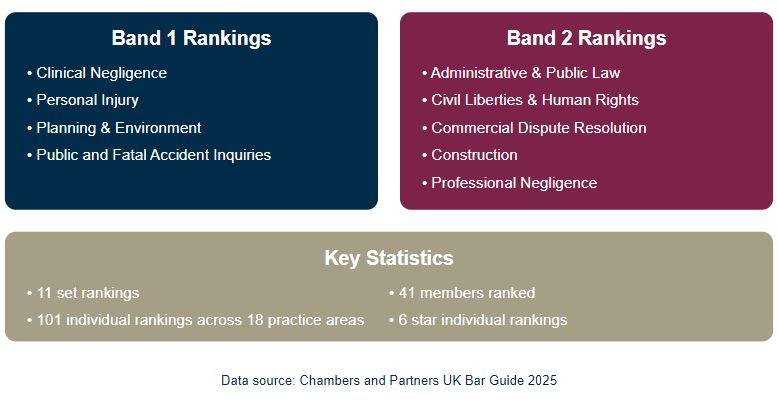
Ampersand Advocates has once again demonstrated its exceptional standing in the Scottish legal landscape, securing top-tier rankings across multiple practice areas in the newly published Chambers and Partners UK Bar Guide 2025. The stable has been recognised as a Band 1 set in Clinical Negligence, Personal Injury, Planning & Environment, and Public and Fatal Accident Inquiries, while achieving Band 2 rankings in Administrative & Public Law, Civil Liberties & Human Rights, Commercial Dispute Resolution, Construction, Professional Negligence, Real Estate Litigation, and Restructuring/Insolvency.
This performance underscores Ampersand’s breadth and depth of expertise, with the stable boasting a total of 11 set rankings and an impressive 101 individual rankings across 18 areas of practice for 41 members, which includes 6 “star individual” rankings.
Key highlights from the guide include:
- Administrative & Public Law: The stable is praised for its “impressive number of highly-rated junior and senior counsel” and their involvement in significant constitutional and human rights issues. Notable practitioners include Aidan O’Neill KC, Douglas Ross KC, Ian Forrester KC, Laura-Anne van der Westhuizen KC, Paul Reid KC, Timothy Young, and Usman Tariq KC.
- Civil Liberties & Human Rights: Ampersand is recognised for representing both private individuals and public bodies in significant proceedings. Aidan O’Neill KC, Douglas Ross KC, and Usman Tariq KC are highlighted for their expertise in this area.
- Clinical Negligence: Described as a “go-to chambers for medical negligence work”, Ampersand’s advocates are lauded for their expert legal advice and representation in a wide range of disputes. Notable practitioners include Maria Maguire KC, Euan Mackenzie KC, Lauren Sutherland KC, Lisa Henderson KC, Mark Fitzpatrick, Simon Bowie KC, Una Doherty KC, Geoffrey Mitchell KC, Graham Primrose KC, Isla Davie KC, Jamie Dawson KC, Jennifer Nicholson-White, Philip Stuart, Vinit Khurana KC, Shane Dundas, Fiona Drysdale KC, James McConnell KC, and Paul Reid KC.
- Commercial Dispute Resolution: The stable is admired for its skilful work in high-profile commercial disputes. Robert Howie KC, Ross Anderson, Timothy Young, Giles Reid, Eoghainn MacLean, Graeme Hawkes KC, Laura-Anne van der Westhuizen KC, Mark Boni, Michael Way, Nicholas McAndrew, Paul Reid KC, and Usman Tariq KC are recognised for their expertise in this area.
- Company: Ross Anderson and Timothy Young are ranked as Band 1 practitioners in this area.
- Construction: Ampersand offers significant experience in advising clients on a range of building and construction works in Scotland. Robert Howie KC, Timothy Young, and Nicholas McAndrew are highlighted for their expertise.
- Employment: Aidan O’Neill KC is ranked as a Band 2 practitioner in this area.
- Information Technology: Usman Tariq is recognised as a New Silk in this area.
- Intellectual Property: Usman Tariq is recognised as a New Silk in this area.
- Media Law: Usman Tariq is recognised as a New Silk in this area.
- Personal Injury: Ampersand is highly regarded for personal injury matters, with members acting for both pursuers and defenders. Notable practitioners include Graham Primrose KC, Maria Maguire KC, Euan Mackenzie KC, Lisa Henderson KC, Simon Di Rollo KC, Douglas Ross KC, Jennifer Nicholson-White, Alan Cowan, Christian Marney, Isla Davie KC, and Shane Dundas.
- Planning & Environment: The stable is well-regarded for complex planning and environmental work. Malcolm Thomson KC, Ailsa Wilson KC, Laura-Anne van der Westhuizen KC, Marcus McKay KC, and Nicolas McAndrew are recognised for their expertise in this area.
- Product Liability: Paul Reid KC is recognised as a New Silk in this area.
- Professional Negligence: Ampersand is recognised as a leading stable for professional liability matters in Scotland. Paul Reid KC and Usman Tariq KC are highlighted for their expertise in this area.
- Public & Fatal Accident Inquiries:Ampersand offers unparalleled bench strength across seniorities in the Scottish inquiries space. Notable practitioners include Geoffrey Mitchell KC, Jamie Dawson KC, Jennifer Nicholson-White, Lisa Henderson KC, Simon Bowie KC, Susanne Tanner KC, Ayla Iridag, Michael Way, Fiona Drysdale KC, James McConnell KC, and Paul Reid KC.
- Real Estate Litigation: Ampersand offers a strong bench of well-regarded advocates active across a broad range of real estate litigation topics. Ross Anderson, Timothy Young, Giles Reid, Robert Howie KC, Mark Boni, and Michael Way are recognised for their expertise in this area.
- Restructuring/Insolvency: Ampersand is well-regarded for handling a wide range of restructuring and insolvency matters. Robert Howie KC, Ross Anderson, and Usman Tariq KC are highlighted for their expertise in this area.
- Tax: Julian Ghosh KC is ranked as a Star Individual, while Ross Anderson is ranked in Band 2 for this area.
In additional to these Scottish bar listings, Ampersand has members recognised in the London Bar where Julian Ghosh KC is Band 1 ranked in 3 tax areas, Aidan O’Neill KC is Band 2 listed for European Law, and Susanne Tanner KC has a spotlight listing for Independent Investigations in the All Circuits region.
The Ampersand clerks have again garnered widespread praise for their exceptional clerking services, with numerous sources highlighting the team’s efficiency, responsiveness, and proactive approach. The clerks are described as friendly, helpful, and pragmatic, offering first-class service that aligns with the commercial realities of litigation. Overall, Ampersand’s clerking team is recognised for delivering a consistently high standard of service.
These outstanding rankings reaffirm Ampersand Advocates’ position as a leading stable in Scotland, offering exceptional expertise across a wide range of practice areas. The stable’s commitment to excellence and depth of talent backed by exceptional clerking, continues to give instructing agents confidence when instructing an Ampersand advocate.
All of the Ampersand rankings can be viewed on the Chambers and Partners website here.
Back
Ampersand Advocates Welcomes Joanna Cherry KC
Ampersand Advocates is thrilled to announce the return of Joanna Cherry KC to practice at the Scottish bar. Joanna, a distinguished advocate with a remarkable career spanning law and politics, is joining Ampersand Advocates. She brings with her a wealth of experience in human rights, public law, criminal law, constitutional matters, medical-legal matters and in fatal accident inquiries.
 Called to the bar in 1995 and taking silk in 2009, Ms. Cherry has established herself as a formidable presence in the legal world. Her extensive experience includes serving as a standing Junior to the Scottish Government and as an advocate depute. Prior to her political career, she built a successful appellate practice, regularly appearing before the UK Supreme Court as well as handling complex medical-legal cases and fatal accident inquiries.
Joanna served as the Member of Parliament for Edinburgh South West from 2015 to 2024. During that time, she was the front bench spokesperson for her party on justice and home affairs from 2015 to 2021. Thereafter she chaired parliament’s influential Joint Committee on Human Rights .
Her parliamentary tenure was marked by significant legal achievements, including her involvement in high-profile constitutional litigation that took her to both the European Court of Justice and the UK Supreme Court. Notably, she led the Scottish litigation that resulted in Boris Johnson’s prorogation of Parliament being ruled unlawful.
Joanna’s exceptional work has been widely recognised. She was awarded the Herald’s “Best Scot at Westminster” in 2019 and Holyrood magazine’s equivalent award in 2021. She is also an Honorary Bencher of the Middle Temple. The Legal 500 have recognised her as a leading silk in the criminal field and in personal injury, medical negligence and professional negligence where she was described as ‘Fearless in her pursuit of a satisfactory outcome for the client.’
Ampersand’s Practice Manager, Alan Moffat, expressed enthusiasm about Joanna joining the Stable: “We are delighted to welcome Joanna to Ampersand. Her expertise in human rights and public law, combined with her recent experience in high-level constitutional matters, along with her medical and FAI experience, will be an invaluable asset to our stable. Joanna’s addition reinforces our commitment to providing the highest caliber of legal representation to those instructing counsel.”
Ampersand is a leading Scottish Stable with recognised experience across Clinical Negligence and Personal Injury, Public and Planning law, and Commercial and Alternative Dispute resolution. Joanna Cherry’s inclusion in its ranks with 27 other senior counsel and 34 junior counsel further enhances Ampersand’s reputation as a leading force for those looking in instruct Scottish Counsel.
Ampersand is a tier 1 set with the leading legal directories across multiple practice areas and is the Scottish “Stable of the year” at the Legal 500 Scottish Awards 2023.
You can view Joanna Cherry KC’s profile here.
For any enquiries about instruction Counsel, please contact the Ampersand Clerking Team: ampersandclerks@advocates.org.uk.
Back